In Plain Terms
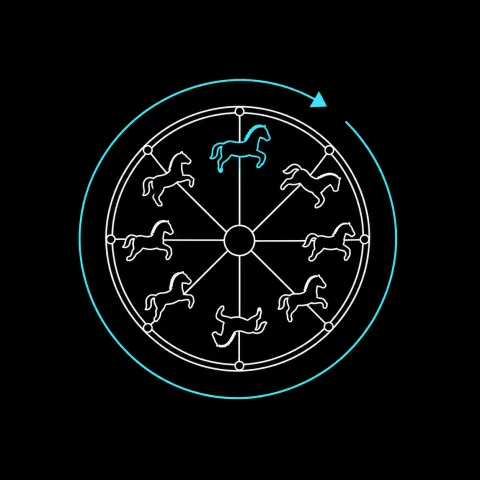
Picture a merry-go-round seen from far away, too far to count the horses. Time one painted horse as it comes round, and that single lap tells you how the whole ride moves. Shor's algorithm uses the same trick. From the large number, it builds a list of numbers that repeats itself, like the horse coming round. A quantum computer can measure the length of that cycle quickly, and the two numbers follow from it. The machine is sometimes wrong, so an ordinary computer checks each answer.
What It Changes for a Business
Shor's algorithm threatens one part of encryption: the methods that let two computers agree on a secret and prove who they are, as on secure websites and in electronic signatures. Those are the ones to replace. The encryption that protects the data itself holds up with long enough keys, according to the UK's National Cyber Security Centre. So when a supplier calls a product quantum-safe, ask which part it covers.
What People Get Wrong
Every so often, a headline says that a quantum computer has cracked an encryption key. These stories describe other methods, tested on small numbers. The largest number broken down with Shor's algorithm on a quantum computer is 21 (3 × 7), in 2012, and the team simplified the calculation using what they already knew of the answer.
Where It Stands Today
Estimates of the machine needed keep getting smaller. In 2019, breaking a standard key took 20 million fragile qubits on paper. In May 2025, Craig Gidney of Google brought that below one million, for under a week of calculation. No machine of that size exists yet, and the method, ready since 1994, is waiting for the hardware.
Related Terms
Quantum computer · Superposition · Post-quantum cryptography · Q-Day