What Is Q-Day?

At the end of the 1990s, companies spent years preparing for a single night, 31 December 1999, when older computers risked misreading the new year. Q-Day is often compared to that deadline. It is the day a quantum computer becomes powerful enough to break the encryption that protects most online connections today. One thing sets it apart from the year 2000: nobody knows when it will come.

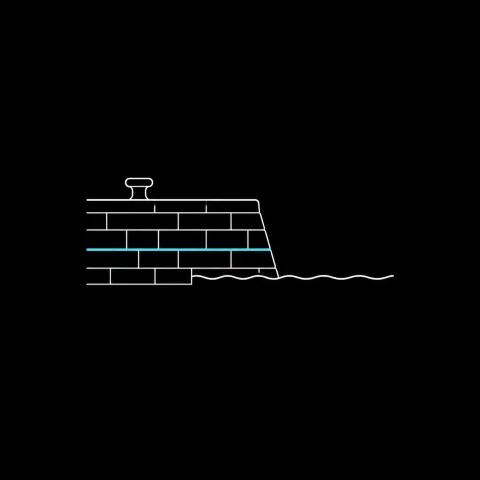
Diagram of Q-Day: a harbour wall with a line painted on it, and calm water standing a little below the line

In Plain Terms

Imagine a harbour wall with a line painted on it. The water rises a little each year, and Q-Day is the day it reaches the line. Two things bring that day closer: quantum machines keep growing, which raises the water, and researchers keep finding cheaper attacks, which lowers the line. In a real harbour, anyone on the quay can see how far the water still has to rise. With Q-Day, nobody can measure that distance precisely.

What It Changes for a Business

How do you prepare for a day without a date? In 2015, Michele Mosca, a researcher at the University of Waterloo, proposed a simple sum: the number of years your data must stay secret, plus the number of years you need to change your encryption. If Q-Day arrives before that total has run out, the data is already exposed, because it can be copied today and read later. Records that must stay confidential for ten years, with a five-year project to change the encryption, are at risk from any Q-Day in the next fifteen years. So start by listing how long each kind of data must stay secret.

What People Get Wrong

Search for Q-Day and you will find countdown clocks giving a precise year. None of these dates comes from a standards body or a research institution, and each rests on its author's own assumptions. They are best treated as illustrations.

Where It Stands Today

The best available figures come from surveys of experts. In the latest, published on 9 March 2026 by the Global Risk Institute in Canada, the 26 specialists consulted put the chance of such a machine at under one in two within ten years, and over one in two within fifteen. Regulators have not waited for an answer. Their deadlines fall between 2030 and 2035, and those are the dates to plan around.

Related Terms

Post-quantum cryptography · Shor's algorithm · Quantum computer · Qubit

Frequently Asked Questions

It is the informal name for the day a quantum computer can break the public-key encryption behind today's online security, such as RSA and elliptic-curve cryptography. No standards body defines it or gives it a date.

Nobody knows. Expert surveys give ranges of probability rather than a date. The latest, published in March 2026, found that the experts consulted expect the threat sooner than in previous editions.

Yes, the two names describe the same moment. Y2Q stands for "years to quantum" and echoes Y2K, the year-2000 computer bug. Unlike Y2K, Q-Day has no fixed date, which makes it harder to plan for.

Public-key methods such as RSA, Diffie-Hellman and elliptic-curve cryptography, which protect web connections and digital signatures. Symmetric encryption such as AES and the standard hash functions hold up with adequate key sizes.

Not necessarily. Whoever builds the first capable machine would gain more by using it quietly than by announcing it. Wartime codebreaking offers a precedent: the breaking of the German Enigma cipher stayed secret for decades.

It is the practice of copying encrypted data today and keeping it until a quantum computer can read it. It explains why data that must stay secret for many years is exposed well before Q-Day itself.

Sources

1. Mosca, M., Cybersecurity in an era with quantum computers: will we be ready?, IACR ePrint 2015/1075, 2015.

2. Mosca, M. & Piani, M. (evolutionQ), Quantum Threat Timeline Report 2025, Global Risk Institute, 9 March 2026 (survey of 26 experts).

3. NIST, IR 8547 Transition to Post-Quantum Cryptography Standards, final version, 27 October 2026.

Back to top