What Is Quantum Superposition?

A door is either open or shut. The very small objects that make up the world do not work this way. Superposition is the ability of a quantum object to hold several possible states at once, rather than one. The combination lasts only while the object is left alone. Look at it, and you get a single ordinary answer.

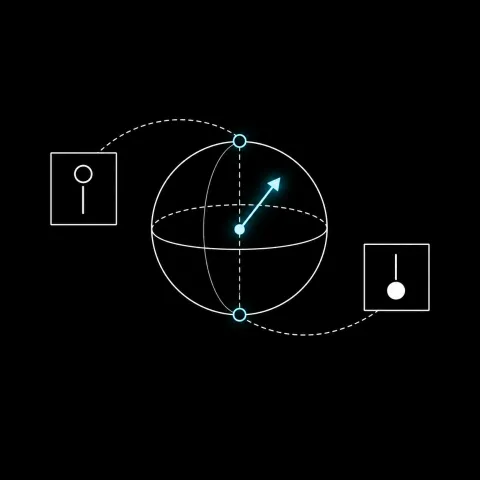
Diagram of quantum superposition: a qubit's arrow on a sphere points between the 0 and 1 poles

In Plain Terms

Think of a piano chord. Three notes are played together and you hear one sound. Here is where the chord stops working. A trained ear can pick out each of the three notes, and listening changes nothing. A quantum state cannot be heard that way. Measure it and you get one note. The rest of the chord is gone for good.

What It Changes for a Business

Superposition is a condition, not a product. A supplier that mentions it has said nothing about what its machine can run. The number to ask for is how long the state lasts before the surroundings destroy it. In November 2025, a team at Princeton reported a record of 1.68 thousandths of a second. Every operation has to finish inside that window.

Superposition already earns money outside computing: atomic clocks run on it, and they keep satellite navigation in step.

What People Get Wrong

A particle in superposition is not in two places at once. Position is only one of the things a quantum state describes, and the state is a single one. Measure where the particle is and it turns up in one place.

Where It Stands Today

Superposition is no longer a matter of single particles. In January 2026, a team in Vienna held a grain of sodium of several thousand atoms in a combined state for a hundredth of a second. That is still far from an everyday object. The gap keeps closing. Nothing in the theory says where it stops.

Related Terms

Qubit · Quantum entanglement · Quantum computer · Quantum mechanics

Frequently Asked Questions

It is a quantum object holding several possible states at once instead of a single one. The combination lasts only while nothing disturbs the object, and measuring it returns one ordinary result.

No, and the difference decides whether a quantum computer is worth anything. A card face down on a table already has a value. A quantum object in superposition holds no hidden value until it is read.

Atomic clocks rely on it, and they keep satellite navigation and financial trading synchronised. Quantum gravimeters use it to survey the ground under a building site. Both are sold products, not prototypes.

Superposition describes one object holding several states. Entanglement describes two objects sharing one state, so that their results always match. Entanglement needs superposition; superposition does not need entanglement.

The superposition ends. One ordinary value comes out, the object is left in the state that was observed, and the combination that existed a moment earlier cannot be recovered.

Yes, in a laboratory. The current reference point is a grain of sodium of several thousand atoms, held in a combined state in Vienna in January 2026. Keeping an object undisturbed gets harder as it gets heavier.

Sources

1. de Leon, N. et al., Millisecond lifetimes and coherence times in 2D transmon qubits, Nature, 5 November 2025, doi 10.1038/s41586-025-09687-4 (Princeton University).

2. Pedalino, S., Gerlich, S., Arndt, M. et al., quantum interference of metallic nanoparticles (5,000 to 10,000 atoms), Nature, 21 January 2026, doi 10.1038/s41586-025-09917-9 (University of Vienna).

Back to top