What Is a Quantum Computer?

An ordinary computer works with bits, tiny switches that are either 0 or 1. A quantum computer is a machine that uses qubits, which can be 0 and 1 at the same time, and the rules of quantum physics to solve certain problems far faster than any ordinary computer can. The idea goes back to 1982, when the physicist Richard Feynman argued that nature, being quantum, would be best simulated by a machine built on the same rules.

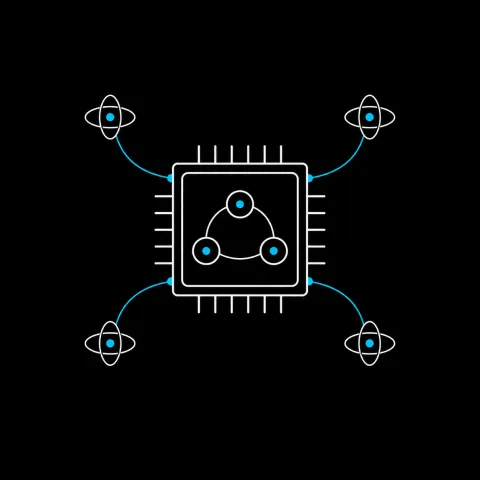
Diagram of a quantum computer: a processor chip holding linked qubits, wired to four atom symbols

In Plain Terms

Picture ripples on a pond. Where two waves meet crest to crest, they grow; where a crest meets a trough, they cancel out. A quantum computer calculates in the same way. Its qubits hold many possibilities at once, and the program is written so that the wrong answers cancel each other out while the right one grows stronger. The image stops at the end of the calculation. On a pond you can watch every wave, whereas a quantum computer shows a single answer each time it runs. So the program runs thousands of times, and the result that comes up most often is the one to keep.

What It Changes for a Business

For most companies in 2026, getting ready for quantum computing starts with people. Machines are rented by the hour through the cloud, so the first investment is a team that understands what they can do. Companies are already moving: according to BCG, business spending on quantum computing reached 550 million dollars in 2025.

One consequence concerns every organisation, whether or not it ever uses a machine. A large enough machine could break the encryption that protects internet traffic, and the estimate of what that takes keeps falling: 20 million qubits in 2019, below one million in May 2025. New encryption standards were published in August 2024, and moving to them is work that can start now.

What People Get Wrong

A common idea is that quantum computers will one day replace the computer on your desk. In fact, they are built for a particular family of problems, such as simulating molecules or breaking certain codes, and they are slower at everyday tasks. The two kinds of machine are designed to work side by side.

Where It Stands Today

The largest machines have more than a thousand qubits, but only some can be relied on: the best published result is 96 reliable qubits, in January 2026. IBM aims for 200 reliable qubits in 2029 and 2,000 in 2033. Progress is now measured in reliable qubits, and that is the figure to follow in the years ahead.

Related Terms

Qubit · Superposition · Quantum entanglement · Quantum mechanics

Frequently Asked Questions

It is a machine that stores information in qubits instead of bits and uses the rules of quantum physics to solve some problems much faster than an ordinary computer. An ordinary computer prepares the work and reads the answer.

Yes. They run real programs on real hardware, and many can be used through the cloud today. None has yet solved a business problem better than an ordinary computer, and reaching that point is the main goal of current research.

The largest machines passed a thousand qubits in 2025. The figure that decides what a machine can run is the number of reliable qubits, and the highest independently published result is 96, from January 2026.

Not today. A large enough machine could break the encryption that protects internet traffic, and the estimates of what that takes keep falling, though they remain far above what exists. Replacement standards were published in 2024, which is why organisations are advised to start preparing now.

Through the cloud, in almost every case. The main cloud platforms offer hardware from several makers, rented by the hour, which lets a company experiment without buying a machine.

Three areas have the strongest evidence today: simulating chemistry and materials, breaking some of today's encryption, and certain search problems. Research is exploring many other uses, where results are still to come.

Sources

1. Feynman, R., Simulating Physics with Computers, International Journal of Theoretical Physics, 1982.

2. BCG, CEOs Need to Shape Where Quantum Creates Value, June 2026 (enterprise spending in 2025).

3. Gidney, C. & Ekerå, M., How to factor 2048-bit RSA integers in 8 hours using 20 million noisy qubits, 2019 · Gidney, C., How to factor 2048-bit RSA integers with less than a million noisy qubits, Google Research, May 2025.

4. NIST, FIPS 203 / 204 / 205, 13 August 2024.

5. QuEra Computing, with Harvard and MIT, 96 logical qubits from 448 atoms, Nature, January 2026 · IBM Quantum, development roadmap (200 logical qubits in 2029, 2,000 in 2033), 2025.

Back to top