Berlin, 1932: a manuscript vanishes
In real history, John von Neumann published Mathematical Foundations of Quantum Mechanics in German in 1932. The book gave the theory the mathematical language it still uses today. The graphic novel imagines a different history. In Berlin, the young mathematician finishes his manuscript, then disappears with his briefcase on a railway platform, bound for Copenhagen.
Six years later in Paris, Camille, a physicist, and Noëmie, an archivist, find a Greek word pencilled beside von Neumann's name in the proceedings of the 1927 Solvay Conference: δύναμις (dynamis), Aristotle's word for potentiality. The clue takes them to Copenhagen, to Niels Bohr and Werner Heisenberg, with censors hot on their heels.
Camille and Noëmie are fictional characters, inspired by two members of the EDHEC Quantum Institute team: Camille Georges, Deputy Director, and Noëmie Nevers, Head of Communications.
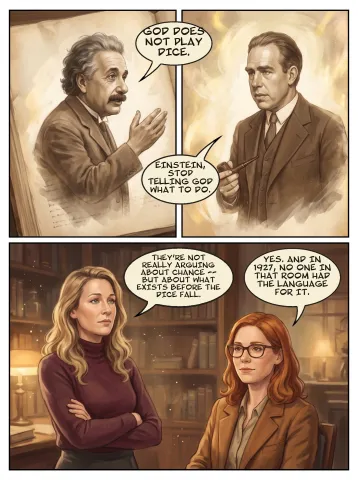
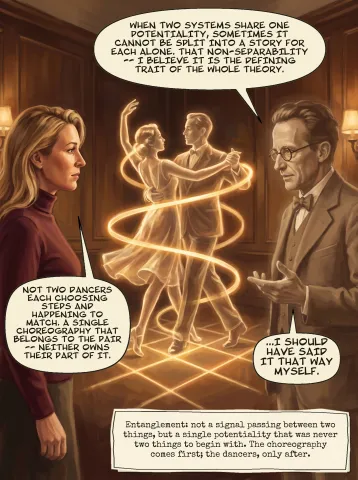
An imaginary tribunal with Einstein, Bohr, Heisenberg and Schrödinger
Back in Paris, Camille summons the founders of the theory in her mind. On trial is an idea: that before it is measured, reality is made of structured potentialities. Einstein opens the attack.
The dialogue is a reconstruction, faithful to the positions these physicists held, notably at the 1927 Solvay Conference. An authors' note at the end of the book separates documented history from fiction.
What the graphic novel explains about quantum physics
Each stage of the investigation introduces a concept. A simple die and light passing through two slits explain interference. The Born rule links the wave function to probabilities. Measurement, superposition, quantum entanglement and decoherence follow. Noëmie has never studied physics, so her questions are the reader's, and Camille answers them step by step.
The final part leaves 1939 for a present-day laboratory, where these ideas have become technologies: qubits, error correction, hardware platforms and quantum communication.
The book also corrects several common misconceptions:
A qubit is "0 and 1 at once".
In the book, it is not yet 0 or 1.
A conscious mind is needed for a measurement to happen.
A physical trace is enough, such as a photographic plate or a detector.
Entanglement could be used to communicate instantly at a distance.
In reality, the measurement results are linked, but they cannot be used to send an instant message.
A quantum computer would be faster at solving everything.
In reality, it can only offer an advantage on certain types of problem.
The authors
Lionel Martellini wrote the story and script. Professor of Finance at EDHEC Business School and Founding Director of EDHEC Quantum Institute, he holds PhDs in finance (University of California, Berkeley) and astrophysics (Université Côte d'Azur).
Yuval Boger handled editing, art direction and production. Trained as a physicist, he is Chief Commercial Officer at QuEra Computing and hosts The Superposition Guy's Podcast, where the two authors first met.
The book at a glance
- Title
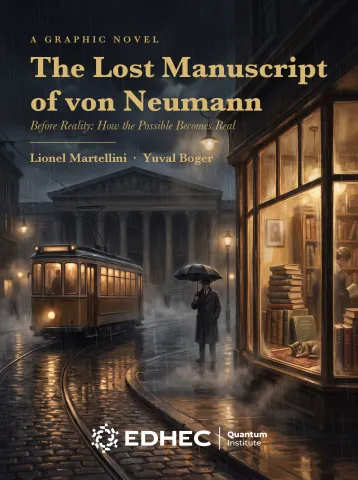
- The Lost Manuscript of von Neumann. Before Reality: How the Possible Becomes Real
- Authors
- Lionel Martellini and Yuval Boger
- Genre
- graphic novel
- Published
- 24 October 2026
- Pages
- 134
- Formats
- paperback, hardback, Kindle
- ISBN (paperback)
- 979-8189873560
- French edition
- Le Manuscrit perdu de von Neumann, published the same day
Buy on Amazon