In Plain Terms
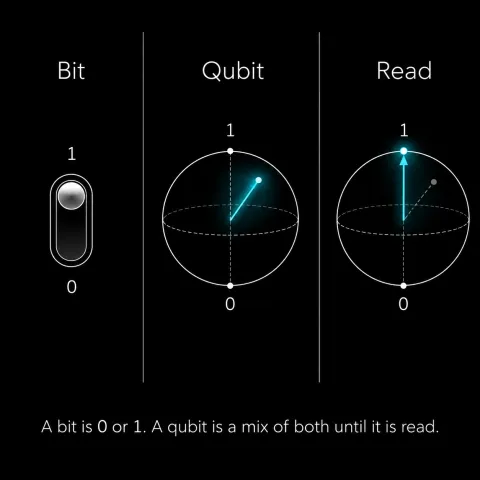
Think of a coin spinning on a table. While it spins, it is neither heads nor tails. When it falls, it lands on one side. The image has a limit, though. A spinning coin already has a side facing up; we just cannot see it. A qubit hides no answer. The result is only decided at the moment it is read.
What It Changes for a Business
Qubits are fragile: the slightest disturbance makes them lose their information. To get one qubit that can be relied on, you have to combine many fragile ones, sometimes hundreds. So when a company announces a computer with 1,000 qubits, ask how many of them are reliable. The answer is always far fewer.
This matters for data security. In 2019, experts estimated that breaking the encryption protecting much of the internet would take 20 million qubits. In 2025, that estimate fell below one million.
What People Get Wrong
A quantum computer does not test every possible answer at the same time. It works by making the wrong answers disappear so that the right one comes out. That is why it is only faster for certain problems.
Where It Stands Today
The most advanced machines now have hundreds or thousands of qubits, but far fewer reliable ones. IBM aims to reach 200 reliable qubits by 2029. The question is no longer how many qubits a machine has, but how many it can trust.
Related Terms
Superposition · Quantum entanglement · Quantum computer · Quantum mechanics