In Plain Terms
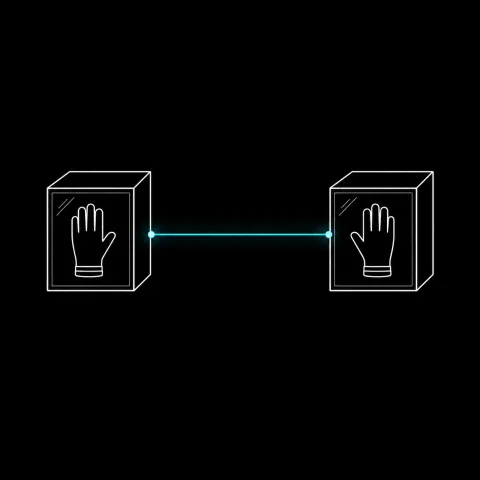
Picture a pair of gloves. One goes in each of two boxes, and the boxes travel to different countries. Opening one tells you what is in the other. The gloves get one thing wrong. They were a left and a right before anyone looked. Entangled objects are not: neither holds an answer until it is measured.
What It Changes for a Business
Entanglement is sold today as a way to protect a communication line. Anyone listening in disturbs what is sent, so the intrusion shows up. Governments and banks buy it for a few dedicated links.
Now the part that matters: it is slow, and it protects the line only. In 2020, a Chinese satellite shared a secret key between two ground stations 1,120 kilometres apart, at one eighth of a bit per second. That is a rate for keys, not for traffic. So when someone offers an unhackable quantum internet, ask what is protected. The line is. The computers at each end are not.
What People Get Wrong
One mistake comes up constantly. Entanglement does not carry messages faster than light. To send anything you would have to choose the result you get, and you cannot: your own result is random. The two sides find out that their results match by comparing notes over an ordinary phone line.
Where It Stands Today
Inside a machine, entanglement is now routine engineering. Over distance the record links need a satellite or a dedicated cable, and carry a trickle. Einstein raised entanglement in 1935 as an objection to quantum theory. It is now a line in a purchase order.
Related Terms
Qubit · Superposition · Quantum computer · Quantum mechanics